1. Northern Ireland has its own established church.
Answer: B — False
9 questionswith answers
Questions cover the religious make-up of the UK, the established church, major places of worship and the principle that people are free to practise their faith or none. Definitions and proportions matter here.
The UK is a multicultural and multi-faith society with a diverse range of religious beliefs and practices. Religion has played a significant role in the country's history and continues to influence its culture, laws, and customs. While Christianity remains the largest religion, the UK is also home to significant communities of Muslims, Hindus, Sikhs, Jews, Buddhists, and people of other faiths, as well as those who identify as non-religious. The UK values freedom of religion and belief, and there are legal protections in place to ensure that people can practice their faith without discrimination.
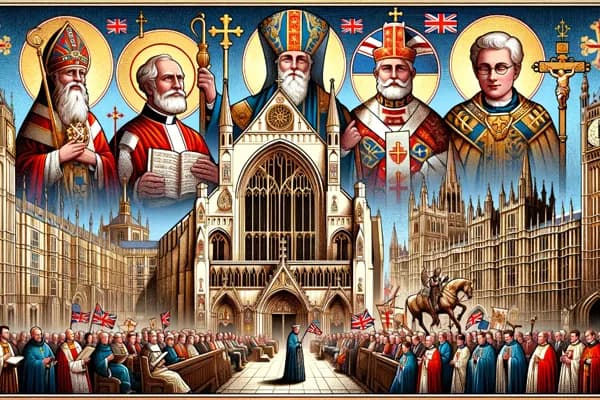
Christianity is the largest religion in the UK, with its roots deeply embedded in British history, culture, and institutions. The Church of England, also known as the Anglican Church, is the established church in England. It is led by the Archbishop of Canterbury and has a unique status as the state church, meaning that it is officially recognized by the government. The British monarch, currently King Charles III, serves as its Supreme Governor, and the Church of England plays a role in certain state ceremonies and events.
In addition to the Church of England, other branches of Christianity have a strong presence in the UK:
Christian festivals such as Christmas and Easter are national holidays and are widely celebrated across the UK, even by those who do not actively practice Christianity.
Islam is the second-largest religion in the UK. The Muslim population is diverse, including people of Pakistani, Bangladeshi, Indian, Middle Eastern, African, and British descent. The majority of Muslims in the UK follow Sunni Islam, though there is also a significant Shia Muslim community.
Muslims in the UK actively practice their faith, with mosques found in cities and towns across the country. Many Muslims observe religious practices such as daily prayers, fasting during Ramadan, and celebrating Eid al-Fitr and Eid al-Adha. The UK’s Muslim community has made significant contributions to various aspects of society, including business, politics, culture, and sports.
Hinduism is practiced by a sizable community, primarily among those of Indian origin. The Hindu community in the UK has established numerous temples and cultural organizations that serve as centers for worship, cultural activities, and community support. Major Hindu festivals, such as Diwali (the Festival of Lights), are widely celebrated, and events are often organized in major cities, attracting participants from across the UK.
The UK has a significant Sikh population, particularly in cities like London, Birmingham, and Leicester. Sikhs in the UK have built many Gurdwaras (places of worship) that serve as important religious, social, and cultural centers. Sikh values emphasize equality, community service, and sharing with others, which are reflected in the tradition of Langar (community kitchen) provided in Gurdwaras. Major Sikh festivals, such as Vaisakhi, which marks the Sikh New Year and the formation of the Khalsa, are celebrated with enthusiasm, including large processions and community events.
Judaism is one of the oldest religious communities in the UK, with a history dating back to medieval times. The Jewish community in the UK is diverse, with a mix of Orthodox, Reform, Conservative, and Liberal traditions. Jewish religious life centers around synagogues and community organizations, which provide places for worship, education, and community support. Major Jewish festivals, such as Passover, Yom Kippur, and Hanukkah, are celebrated with family gatherings, prayers, and communal activities.
Buddhism is practiced by both British-born individuals and immigrants, particularly those from countries such as Sri Lanka, Thailand, Tibet, and China. There are numerous Buddhist centers and temples across the UK, representing different traditions such as Theravada, Mahayana, and Vajrayana. These centers provide spaces for meditation, teaching, and community activities. Significant Buddhist festivals, such as Vesak (Buddha Day), are observed by Buddhists in the UK, reflecting the diversity within the community.
The UK is also home to followers of other religions, such as Jainism, Zoroastrianism, Bahá’í Faith, and Taoism, as well as various pagan and new religious movements. These communities, though smaller in number, contribute to the religious and cultural diversity of the UK. The UK respects all religions and beliefs, allowing individuals to practice their faith freely and contribute to society.
A significant proportion of the UK population identifies as non-religious or secular. This group includes atheists, agnostics, humanists, and those who simply choose not to follow any organized religion. Humanism is one of the more organized non-religious philosophies, promoting ethical living without reference to religious beliefs. The British Humanist Association is one of the key organizations representing non-religious people, advocating for secularism and the separation of religion and state.
The UK is committed to freedom of religion and belief, enshrined in its legal framework. This freedom is protected by various laws, such as the Human Rights Act 1998, which ensures that individuals have the right to practice their religion or belief, or to have no religion at all, without facing discrimination or persecution. The UK government promotes tolerance, understanding, and respect between people of different faiths and beliefs through various policies, education, and community initiatives.
Every question below is shown with the correct answer marked. The real test mixes topics together, so once this one feels comfortable try a full practice test.
Answer: B — False
Answer: A — True
Answer: B — False
Answer: A — 1st March
Answer: B — St Patrick
Answer: A — True
Answer: A — St David
Answer: C — Presbyterian
Answer: D — The monarch