1. Who were the first people to live in Britain in what we call the Stone Age?
Answer: C — Hunter-gatherers
18 questionswith answers
From the earliest settlement through the Roman, Anglo-Saxon and Viking periods up to the Norman Conquest. Questions typically ask who arrived when, and what they left behind.
Stone Age (Hunter-Gatherers)
The first people in Britain were hunter-gatherers who followed herds of deer and horses. Britain was connected to the continent by a land bridge and only became permanently separated about 10,000 years ago.
First Farmers (6,000 years ago)
The first farmers arrived from south-east Europe and built houses, tombs, and monuments. Key sites include Stonehenge in Wiltshire (a special gathering place for seasonal ceremonies) and Skara Brae on Orkney (the best preserved prehistoric village in northern Europe).
Bronze Age (4,000 years ago)
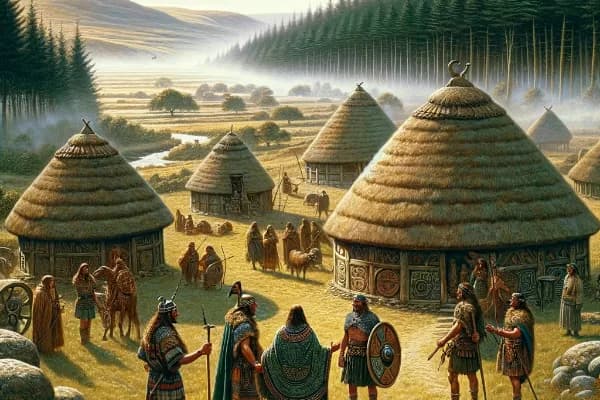
People learned to make bronze, lived in roundhouses, and buried their dead in round barrows. They created beautiful objects in bronze and gold, including tools, ornaments, and weapons.
Iron Age
People made weapons and tools from iron, lived in roundhouses grouped into larger settlements, and built defended hill forts like Maiden Castle in Dorset. They spoke Celtic languages (still spoken in parts of Wales, Scotland, and Ireland today), had a sophisticated culture and economy, and minted the first coins in Britain—marking the beginnings of British history.
The Romans (55 BC - AD 410)
Julius Caesar's invasion in 55 BC was unsuccessful, but Emperor Claudius successfully invaded in AD 43. The Romans faced resistance from tribal leaders like Queen Boudicca. They built Hadrian's Wall to keep out the Picts and remained for 400 years, building roads, public buildings, creating law structures, and introducing Christianity. The Romans left in AD 410.
The Anglo-Saxons (after AD 410)
Following the Roman departure, tribes from northern Europe (Jutes, Angles, and Saxons) invaded. Their languages formed the basis of modern English. By AD 600, Anglo-Saxon kingdoms were established in England, while parts of Wales and Scotland remained free of Anglo-Saxon rule. Christianity spread through missionaries like St Patrick, St Columba, and St Augustine (first Archbishop of Canterbury). Notable burial site: Sutton Hoo in Suffolk, where a king was buried with treasure and armor in a ship.
The Vikings (from AD 789)
Vikings from Denmark and Norway first raided Britain in AD 789, taking goods and slaves. They then began to stay and form communities in the east of England and Scotland. The Anglo-Saxon kingdoms in England united under King Alfred the Great, who defeated the Vikings. Many Viking invaders stayed in Britain, especially in the Danelaw (eastern and northern England—many place names there come from Viking languages). Viking settlers mixed with local communities and some converted to Christianity. Anglo-Saxon kings continued to rule England, except for a brief period of Danish kings, with the first being Cnut (also called Canute). In the north, the threat of Vikings encouraged people to unite under one king, Kenneth MacAlpin, and the term "Scotland" began to be used.
The Norman Conquest (1066)
William, Duke of Normandy (from northern France), defeated Harold, the Saxon king of England, at the Battle of Hastings in 1066. Harold was killed, and William became King of England, known as William the Conqueror. The battle is commemorated in the Bayeux Tapestry. The Norman Conquest was the last successful foreign invasion of England and led to major changes in government and social structures. Norman French became the language of the ruling class and influenced the development of English. The Normans initially conquered Wales, and the Scots and Normans fought on the England-Scotland border, though the Normans took over some land but didn't invade Scotland. William commissioned the Domesday Book, which listed all towns, villages, landowners, people, and animals throughout England—it still exists today.
Every question below is shown with the correct answer marked. The real test mixes topics together, so once this one feels comfortable try a full practice test.
Answer: C — Hunter-gatherers
Answer: A — 55 BC
Julius Caesar led a Roman invasion of Britain in 55 BC.
Answer: C — 1066
Answer: A — The Normans led by William
The Norman Conquest was the last successful foreign invasion of England and led to many changes in government and social structures in England. Norman French, the language of the new ruling class, influenced the development of the English language as we know it today.
Answer: A — South-west Europe
Answer: C — The people of the Iron Age
Answer: B — King Alfred the Great
Answer: B — 400 years
The Romans remained in Britain for 400 years.
Answer: C — Stonehenge
One of these monuments, Stonehenge, still stands in what is now the English county of Wiltshire.
Answer: C — Boudicca
Answer: A — FALSE
The people who lived there, who owned the land and what animals they owned were also listed. This was called Domesday Book. It still exists today and gives a picture of society in England just after the Norman Conquest.
Answer: B — Boudicca
One of the tribal leaders who fought against the Romans was Boudicca, the queen of the Iceni in what is now eastern England.
Answer: C — A land bridge
The first people to live in Britain were hunter-gatherers, in what we call the Stone Age. For much of the Stone Age, Britain was connected to the continent by a land bridge. People came and went, following the herds of deer and horses which they hunted. Britain only became permanently separated from the continent by the Channel about 10,000 years ago.
Answer: D — William of Normandy
In 1066, an invasion led by William, the Duke of Normandy (in what is now northern France), defeated Harold, the Saxon king of England, at the Battle of Hastings.
Answer: A — True
St Augustine became the first Archbishop of Canterbury
Answer: C — The Battle of Hastings
Answer: D — The Norman Conquest
The Norman Conquest of England, a pivotal event in British history, occurred in 1066. It began with the invasion of England by William, the Duke of Normandy, later known as William the Conqueror. This invasion was significant for several reasons: Background : The conquest was set in motion after the death of the English king, Edward the Confessor, in January 1066. The lack of a clear heir led to a power struggle. Harold Godwinson was crowned king, but William of Normandy claimed that Edward had promised him the throne. Battle of Hastings : The decisive moment came on October 14, 1066, at the Battle of Hastings. William's forces defeated the English army led by King Harold II, who was killed in the battle. This victory was a turning point, allowing William to take control of England. Norman Rule : Following his victory, William was crowned King of England on Christmas Day 1066. He implemented Norman governance, which involved the redistribution of land to his Norman supporters, building a network of castles across England for defense and control, and reorganizing the English administrative system. Cultural and Social Impact : The conquest brought significant cultural changes, including the introduction of the Norman French language and culture. It also led to profound cmmmmmhanges in the English aristocracy, architecture, language, and legal systems. Domesday Book : One of the most famous outcomes was the compilation of the Domesday Book in 1086, a great survey of England's land and resources, which was unprecedented in its detail and scope. Long-Term Consequences : The Norman Conquest had a lasting impact on the development of the English language, blending Old English with Norman French, and on the social and political structures of England. In summary, the Norman Conquest was not just a military conquest but a transformation of English society, governance, language, and culture, the effects of which are still evident in modern Britain.
Answer: C — Round barrows
Around 4,000 years ago, people learned to make bronze. We call this period the Bronze Age. People lived in roundhouses and buried their dead in tombs called round barrows.