Menu
The Middle Ages — Life in the UK Test revision topic

History of the UK

The Middle Ages

12 questionswith answers

War, plague, parliament in its earliest form and the growth of English as a written language. Questions here often connect a well-known event to its century.

The Middle Ages: revision notes

The Middle Ages

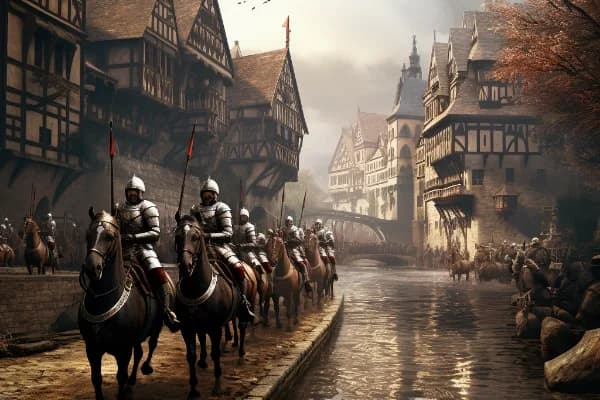
The Middle Ages in Britain, spanning from the end of the Roman Empire around the 5th century to the beginning of the Renaissance in the 15th century, was a period of significant transformation and development. This era is marked by feudalism, the rise of the medieval monarchy, and a series of pivotal events and social changes.

1. Early Middle Ages (500-1066)

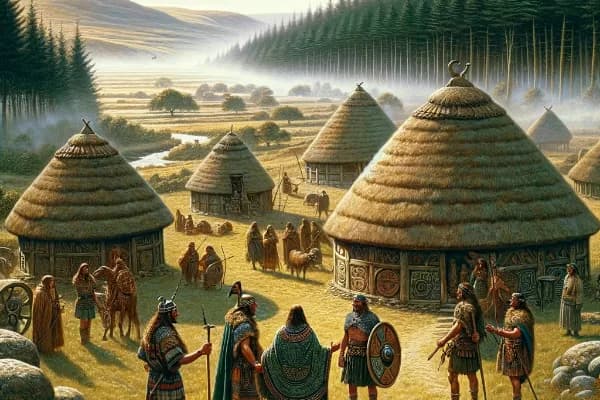
  • Anglo-Saxon Period: Following the decline of Roman rule, Britain saw the establishment of various Anglo-Saxon kingdoms. This period is characterized by the spread of Christianity, with missionaries like St. Augustine of Canterbury playing a crucial role in converting the Anglo-Saxons. The conversion led to the construction of monasteries and the establishment of ecclesiastical institutions.
  • Viking Invasions: From the late 8th century, Viking raids began to affect Britain. The Vikings, originating from Scandinavia, established the Danelaw in parts of England. The invasions led to significant cultural and political changes, including the integration of Norse culture into Anglo-Saxon society.
  • Alfred the Great: King Alfred of Wessex (reigned 871-899) is noted for his defense of England against Viking invasions and his efforts to promote education and legal reform. He laid the foundations for the unification of England under a single monarchy.

2. Norman Conquest and the High Middle Ages (1066-1300)

  • Norman Conquest: The Norman Conquest of 1066, led by William the Conqueror, was a transformative event. William, Duke of Normandy, defeated King Harold II at the Battle of Hastings and became King William I of England. This conquest led to significant changes in land ownership, governance, and culture, including the introduction of Norman law and customs.
  • Domesday Book: Commissioned by William the Conqueror in 1086, the Domesday Book is a comprehensive survey of England’s land and resources. It provided a detailed record of landholdings and was instrumental in the administration of the kingdom.
  • Feudal System: The feudal system, introduced by the Normans, established a hierarchical structure of land ownership and duties. The king granted lands to nobles, who, in turn, provided military service and support. This system shaped medieval society and governance.
  • Magna Carta: In 1215, King John was forced to sign the Magna Carta, a document that limited the powers of the monarchy and established certain legal rights for subjects. The Magna Carta is considered a foundational document in the development of constitutional law.

3. Late Middle Ages (1300-1500)

  • Hundred Years’ War: The Hundred Years' War (1337-1453) was a prolonged conflict between England and France over claims to the French throne. It had significant social, political, and economic impacts, including the rise of nationalism and changes in military tactics.
  • Black Death: The Black Death, or Bubonic Plague, struck Britain in 1348-1349. It led to the death of a significant portion of the population and had profound effects on society and the economy. The labor shortage caused by the plague led to higher wages for workers and changes in land use.
  • War of the Roses: The War of the Roses (1455-1487) was a series of civil wars fought between the rival houses of Lancaster and York over the English throne. The conflict ended with the victory of Henry Tudor (Henry VII) and the establishment of the Tudor dynasty.
  • Tudor Dynasty: The Tudor period began with Henry VII in 1485. The Tudors are noted for their role in centralizing royal power and laying the foundations for the modern British state. Key figures include Henry VIII, known for his role in the English Reformation, and Elizabeth I, whose reign saw the defeat of the Spanish Armada and the flourishing of English Renaissance culture.

4. Social and Cultural Developments

  • Medieval Society: Medieval society was structured around the feudal system, with a rigid class hierarchy. The majority of people were peasants working the land, while the nobility and clergy held significant power and influence. The church played a central role in everyday life, providing education, charity, and spiritual guidance.
  • Education and Learning: The Middle Ages saw the establishment of universities, such as Oxford and Cambridge, which became centers of learning and scholarship. Scholasticism, a method of learning that aimed to reconcile faith with reason, dominated medieval intellectual life.
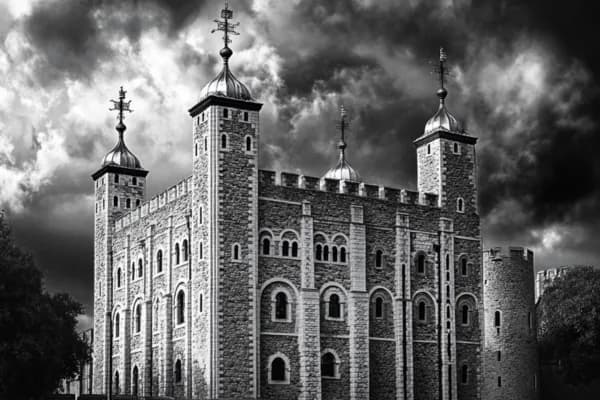
  • Architecture: The period is renowned for its architectural achievements, including the construction of Gothic cathedrals with features like pointed arches, ribbed vaults, and flying buttresses. Notable examples include Canterbury Cathedral and York Minster.

12 practice questions on The Middle Ages

Every question below is shown with the correct answer marked. The real test mixes topics together, so once this one feels comfortable try a full practice test.

3. Which stories are associated with Geoffrey Chaucer?

  1. The Ambridge Tales
  2. The Canterbury Tales
  3. The London Tales
  4. The Westbury Tales

Answer: B — The Canterbury Tales

In the years leading up to 1400, Geoffrey Chaucer wrote a series of poems in English about a group of people going to Canterbury on a pilgrimage. The people decided to tell each other stories on the journey, and the poems describe the travellers and some of the stories they told. This collection of poems is called The Canterbury Tales.

5. What were The Canterbury Tales?

  1. A Royal Charter
  2. A Series of poems
  3. A book of Christian doctrine
  4. A story about Canterbury Cathedral

Answer: B — A Series of poems

The people decided to tell each other stories on the journey, and the poems describe the travellers and some of the stories they told. This collection of poems is called The Canterbury Tales.

7. Which Scottish poet wrote The Bruce about the Battle of Bannockburn?

  1. Geoffrey Chaucer
  2. John Barbour
  3. John Milton
  4. Robert Burns

Answer: B — John Barbour

In Scotland, many people continued to speak Gaelic and the Scots language also developed. A number of poets began to write in the Scots language. One example is John Barbour, who wrote The Bruce about the Battle of Bannockburn.

Take today’s Daily QuizBrowse all topics