34 practice questions on The Tudors and Stuarts
Every question below is shown with the correct answer marked. The real test mixes topics together, so once this one feels comfortable try a full practice test.
- FALSE
- TRUE✓
Answer: B — TRUE
All Scottish clans were required formally to accept William as king by taking an oath. The MacDonalds of Glencoe were late in taking the oath and were all killed.
- Charles I
- Charles II
- Winston Churchill
- Oliver Cromwell✓
Answer: D — Oliver Cromwell
- Ireland
- Northern Ireland
- Scotland
- Wales✓
Answer: D — Wales
During the reign of Henry VIII, Wales became formally united with England by the Act for the Government of Wales. The Welsh sent representatives to the House of Commons and the Welsh legal system was reformed.
- Catholicism
- Hinduism
- Methodism
- Protestantism✓
Answer: D — Protestantism
Protestant ideas gradually gained strength in England, Wales and Scotland during the 16th century.
- Geoffrey Chaucer
- Sir Francis Drake
- William Caxton
- William Shakespeare✓
Answer: D — William Shakespeare
Shakespeare was born in Stratford-upon-Avon, England. He was a playwright and actor and wrote many poems and plays. His most famous plays include A Midsummer Night's Dream, Hamlet, Macbeth and Romeo and Juliet.
- Anne of Cleves
- Catherine Howard
- Catherine Parr
- Jane Seymour✓
Answer: D — Jane Seymour
Jane Seymour - Henry married Jane after Anne's execution. She gave Henry the son he wanted, Edward, but she died shortly after the birth.
- Richard III
- Charles II✓
- James I
- Henry IV
Answer: B — Charles II
- A Spanish princess
- A fleet of Spanish ships✓
- A treaty with Spain
- The Spanish Army
Answer: B — A fleet of Spanish ships
Elizabeth became one of the most popular monarchs in English history, particularly after 1588, when the English defeated the Spanish Armada (a large fleet of ships), which had been sent by Spain to conquer England and restore Catholicism.
- She became Queen of England
- She was sent to France
- She escaped to Denmark
- She was executed✓
Answer: D — She was executed
- True
- False✓
Answer: B — False
During the reign of Henry VIII, Wales became formally united with England by the Act for the Government of Wales.
- Roundheads
- Suffragettes
- Quakers
- Cavaliers✓
Answer: D — Cavaliers
- Her brother
- Her father
- Her husband✓
- Her sister
Answer: C — Her husband
When her husband was murdered, Mary was suspected of involvement and fled to England.
- A war
- A flood
- A fire✓
- An earthquake
Answer: C — A fire
- Bloody Mary
- Charles I✓
- Elizabeth I
- Henry VIII
Answer: B — Charles I
When Charles I inherited the thrones of England, Wales, Ireland and Scotland, he tried to rule in line with this principle. When he could not get Parliament to agree with his religious and foreign policies, he tried to rule without Parliament at all.
- 1466
- 1066
- 1254
- 1588✓
Answer: D — 1588
- True✓
- False
Answer: A — True
His most famous published work was Philosophiae Naturalis Principia Mathematica (''Mathematical Principles of Natural Philosophy'), which showed how gravity applied to the whole universe.
- FALSE✓
- TRUE
Answer: A — FALSE
England declared itself a republic, called the Commonwealth. It no longer had a monarch. For a time, it was not totally clear how the country would be governed. For now, the army was in control.
- True
- False✓
Answer: B — False
In May 1660, Parliament invited Charles II to come back from exile in the Netherlands. He was crowned King Charles II of England, Wales, Scotland and Ireland.
- He died first and she was a widow for the rest of her life
- He died first and she went on to remarry✓
- She died first and he never remarried
- She died in childbirth and Henry remarried
Answer: B — He died first and she went on to remarry
Catherine Parr - Catherine was a widow who married Henry late in his life. She survived him and married again but died soon after.
- FALSE
- TRUE✓
Answer: B — TRUE
He was crowned king of Scotland and led a Scottish army into England.
- James I
- Charles II
- James VII
- Charles I✓
Answer: D — Charles I
- The MacLaine of Lochbuie
- The McDowalls of Garthland
- The Macpherson of Cluny
- The MacDonalds of Glencoe✓
Answer: D — The MacDonalds of Glencoe
- Queen Victoria
- Henry VIII
- Elizabeth I✓
- Charles II
Answer: C — Elizabeth I
- The Reformation✓
- The Enlightenment
- The Glorious Revolution
- The Renaissance
Answer: A — The Reformation
- The 'Glorious Revolution'✓
- The Restoration
- The 'Great Depression'
- The 'Blitz'
Answer: A — The 'Glorious Revolution'
- England
- France✓
- Germany
- Spain
Answer: B — France
Much of her childhood was spent in France. When she returned to Scotland, she was the centre of a power struggle between different groups.
- Children✓
- Government
- Right to the throne
- Wife
Answer: A — Children
Charles II had no legitimate children.
- Henry VIII✓
- Oliver Cromwell
- Winston Churchill
- William of Orange
Answer: A — Henry VIII
- FALSE
- TRUE✓
Answer: B — TRUE
During his reign, the Royal Society was formed to promote 'natural knowledge'. This is the oldest surviving scientific society in the world.
- 15✓
- 18
- 35
- 56
Answer: A — 15
Henry VIII was succeeded by his son Edward VI, who was strongly Protestant. During his reign, the Book of Common Prayer was written to be used in the Church of England. A version of this book is still used in some churches today. Edward died at the age of 15 after ruling for just over six years, and his half-sister Mary became queen.
- Edward I
- Henry V
- Henry VII
- Henry VIII✓
Answer: D — Henry VIII
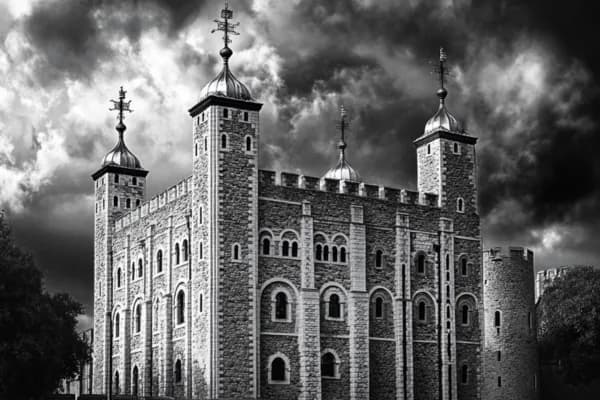
- Houses of the Parliament
- Stonehenge
- Tower of London✓
- Whitehall
Answer: C — Tower of London
- To celebrate his wedding with Anne of Cleves
- To have control over religious people
- To establish a unique religion in England
- To divorce his first wife, Catherine of Aragon✓
Answer: D — To divorce his first wife, Catherine of Aragon
- Manchester
- Oldham
- Stratford-upon-Avon✓
- Lincolnshire
Answer: C — Stratford-upon-Avon