1. Where is the official home of the Prime Minister?
Answer: D — 10 Downing Street
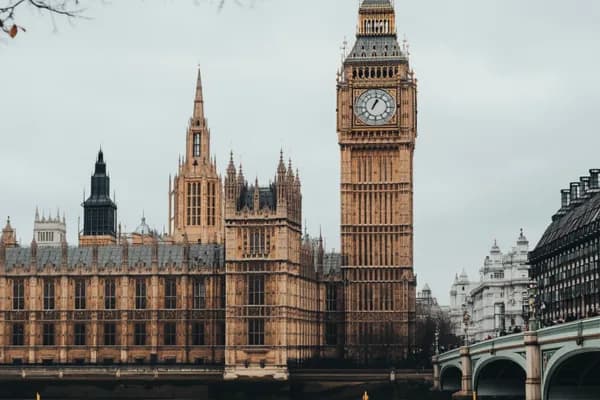
19 questionswith answers
Questions here concern how the UK is actually run day to day — Parliament, the devolved administrations, ministers, the civil service and local government. This is one of the most heavily tested areas, so it repays careful revision.
The UK government is the central authority responsible for making and implementing national policies, passing legislation, and managing public services and resources. It is composed of several branches, each with distinct roles and responsibilities, ensuring a balanced and democratic system. The UK government operates under the constitutional monarchy, where the monarch is the head of state, and an elected government led by the Prime Minister is the head of government.
The executive branch of the UK government is responsible for implementing and enforcing laws. It is headed by the Prime Minister, who is the leader of the political party with the majority in the House of Commons. The Prime Minister is appointed by the monarch and is responsible for leading the government, setting national policies, and representing the UK internationally.
The executive branch includes the Cabinet, a group of senior ministers chosen by the Prime Minister from members of Parliament (MPs) in the House of Commons or members of the House of Lords. The Cabinet is responsible for making key government decisions, coordinating government policy, and overseeing government departments. Each Cabinet minister is in charge of a specific government department, such as health, education, or defense, and is accountable for its operation and policy implementation.
The executive also includes junior ministers, civil servants, and government agencies, who work under the direction of the Cabinet ministers to carry out government functions, develop policies, and provide public services. Civil servants are appointed on merit and remain politically neutral to ensure continuity and stability in the administration of government, regardless of which party is in power.
The legislature is the law-making body of the UK government, known as Parliament. Parliament consists of two houses: the House of Commons and the House of Lords.
The judiciary is the independent branch of government responsible for interpreting and applying the law. It ensures that laws passed by Parliament and implemented by the executive are consistent with the constitution and that justice is administered fairly. The judiciary includes various levels of courts, ranging from magistrates' courts and county courts to higher courts like the High Court, the Court of Appeal, and the Supreme Court of the United Kingdom.
The Supreme Court is the highest court in the UK and serves as the final court of appeal for civil and criminal cases. It is also responsible for resolving disputes over the interpretation of the law, including constitutional matters. The judiciary operates independently of the government, and judges are appointed based on merit to ensure impartiality, fairness, and the rule of law.
The UK is composed of four countries: England, Scotland, Wales, and Northern Ireland. While the UK Parliament in Westminster retains authority over matters affecting the entire country, certain powers have been devolved to regional governments in Scotland, Wales, and Northern Ireland. These devolved administrations have their own parliaments or assemblies and are responsible for making decisions on specific issues, such as health, education, transportation, and local government.
Devolution allows Scotland, Wales, and Northern Ireland to have greater control over local affairs while remaining part of the United Kingdom. However, certain areas, such as defense, foreign affairs, and immigration, remain under the control of the UK Parliament.
Local government plays a vital role in delivering services and managing local affairs within communities across the UK. Local authorities, such as councils, are responsible for services including education, housing, social care, waste management, transportation, and planning. Local councils are made up of elected councillors who represent wards or divisions within the local area. Councillors are elected by local residents in council elections held every four years.
Local governments are funded by a combination of central government grants, local taxes (such as council tax), and business rates. They have a significant degree of autonomy to make decisions that directly affect their local communities. Local councils often work closely with community groups, businesses, and other organizations to address local issues and improve services.
Every question below is shown with the correct answer marked. The real test mixes topics together, so once this one feels comfortable try a full practice test.
Answer: D — 10 Downing Street
Answer: B — Every week
Answer: B — MLAs
There is a power-sharing agreement which distributes ministerial offices amongst the main parties. The Assembly has 108 elected members, known as MLAs (members of the Legislative Assembly). They are elected with a form of proportional representation.
Answer: B — Edinburgh
The Scottish Parliament was formed in 1999. It sits in Edinburgh, the capital city of Scotland.
Answer: D — Policing
Answer: B — TRUE
You can find further information on the UK Parliament website at www.parliament.uk
Answer: C — A poll card
Answer: B — TRUE
Most citizens of the UK, the Irish Republic or the Commonwealth aged 18 or over can stand for public office. There are some exceptions, including: -members of the armed forces ; -civil servants ; -people found guilty of certain criminal offences.
Answer: A — FALSE
Policy and laws governing defence, foreign affairs, immigration, taxation and social security all remain under central UK government control. However, many other public services, such as education, are controlled by the devolved administrations.
Answer: C — Put your name on the electoral register
To be able to vote in a parliamentary, local or European election, you must have your name on the electoral register.
Answer: C — Once a week
One important opportunity to do this is at Prime Minister's Questions, which takes place every week while Parliament is sitting.
Answer: B — TRUE
The main political parties actively look for members of the public to join their debates, contribute to their costs, and help at elections for Parliament or for local government.
Answer: C — Every household receives a registration form, which must be completed and returned
An electoral registration form is sent to every household and this has to be completed and returned with the names of everyone who is resident in the household and eligible to vote.
Answer: D — Wales
Answer: C — The names of all eligible voters who live at the address
The electoral register is updated every year in September or October. An electoral registration form is sent to every household and this has to be completed and returned with the names of everyone who is resident in the household and eligible to vote:
Answer: B — False
Answer: B — False
Answer: A — FALSE
The Scottish Parliament can pass laws for Scotland on all matters which are not specifically reserved to the UK Parliament.
Answer: A — Cardiff
The Welsh government and National Assembly for Wales are based in Cardiff, the capital city of Wales.
 Fundamental Principles5 questions
 How you can support your community5 questions
 Respecting the law9 questions
 The British constitution13 questions
 The development of British democracy3 questions
 The role of the courts11 questions
 The UK and International Institutions5 questions
 Your Role in the Community3 questions