1. How is a jury selected?
Answer: B — Randomly from the electoral register
11 questionswith answers
Questions deal with how justice works in practice — the different courts, who hears which kind of case, juries, magistrates and legal advice. Note that the arrangements are not identical across all four nations.
The courts play a crucial role in the UK’s legal system and constitution, ensuring that laws are applied correctly and that justice is administered fairly. The judiciary operates independently from the government and Parliament, upholding the rule of law, protecting individual rights, and interpreting legislation. The UK’s court system is hierarchical, with different levels of courts handling various types of cases, ranging from minor disputes to significant constitutional matters.
The UK court system is divided into different types of courts, each with specific functions and jurisdictions:
A key principle of the UK’s legal system is judicial independence, which means that the judiciary operates independently of the government and Parliament. This independence ensures that judges can make decisions based on the law and facts of a case without any political pressure or influence. Judicial independence is vital for upholding the rule of law, protecting citizens’ rights, and ensuring a fair and impartial justice system.
The independence of the judiciary is maintained through several mechanisms:
The courts play a critical role in interpreting and applying the law, particularly in cases where legislation is unclear or open to different interpretations. When disputes arise, courts examine the relevant laws, legal precedents, and principles to reach a fair and just decision. The judiciary also ensures that laws passed by Parliament are compatible with the Human Rights Act 1998, which incorporates the European Convention on Human Rights (ECHR) into UK law. If a court finds that a law conflicts with human rights, it can issue a declaration of incompatibility, prompting Parliament to consider amending the law.
Moreover, the courts protect individuals' rights by reviewing the decisions and actions of public bodies, including the government, through a process known as judicial review. Judicial review allows the courts to determine whether a public authority has acted lawfully, fairly, and reasonably. If a public body is found to have acted unlawfully, the court can quash the decision or order it to be reconsidered.
In addition to the main court system, the UK has a range of specialized courts and tribunals that deal with specific types of cases:
Every question below is shown with the correct answer marked. The real test mixes topics together, so once this one feels comfortable try a full practice test.
Answer: B — Randomly from the electoral register
Answer: D — The Justice of the Peace Court
Answer: C — To decide whether the accused is 'guilty' or 'not guilty'
The jury has to listen to the evidence presented at the trial and then decide a verdict of 'guilty' or 'not guilty' based on what they have heard.
Answer: B — Country Court
County Courts deal with a wide range of civil disputes. These include people trying to get back money that is owed to them, cases involving personal injury, family matters, breaches of contract, and divorce.
Answer: C — Magistrates' Court
Answer: A — FALSE
In England, Wales and Northern Ireland, if an accused person is aged 10 to 17, the case is normally heard in a Youth Court in front of up to three specially trained magistrates or a District Judge.
Answer: B — TRUE
The small claims procedure is an informal way of helping people to settle minor disputes without spending a lot of time and money using a lawyer.
Answer: A — FALSE
There are some differences between the court systems in England and Wales, Scotland and Northern Ireland.
Answer: C — Solicitors
Solicitors are trained lawyers who give advice on legal matters, take action for their clients and represent their clients in court. Solicitors' charges are usually based on how much time they spend on a case. It is very important to find out at the start how much a case is likely to cost.
Answer: C — 15
Answer: C — 15
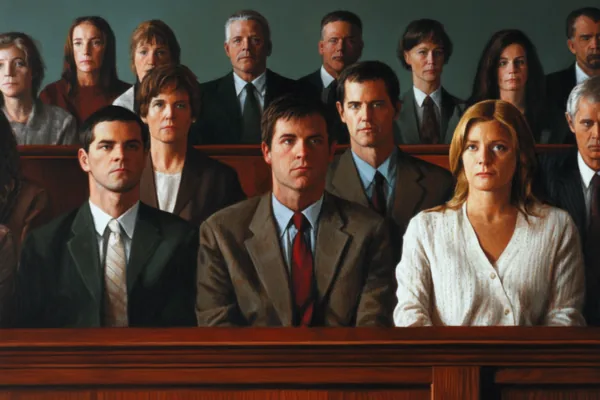
A jury is made up of members of the public chosen at random from the local electoral register (see page 134). In England, Wales and Northern Ireland a jury has 12 members, and in Scotland a jury has 15 members.
 Fundamental Principles5 questions
 How you can support your community5 questions
 Respecting the law9 questions
 The British constitution13 questions
 The development of British democracy3 questions
 The Government19 questions
 The UK and International Institutions5 questions
 Your Role in the Community3 questions